Brighton Tram 53 Society
Construction of the Tramway & Braking
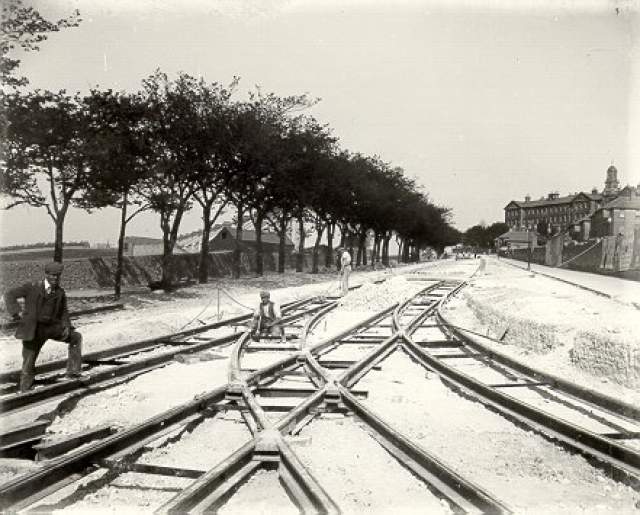
Most people would think logically that if you built a tramway in the town, there would be, for each route, an up line and a return line similar to trains, but because the majority of the streets of Brighton are narrow, and delivery vehicles unload at the side of the road, that changes how you design where to put the rails.
The Brighton Corporation Tramways placed their tram lines directly down the middle of the road (the centre crown of the street) along almost the entire length of the network. The placement followed a strict engineering logic to balance traffic flow, public safety, and the limits of the city's narrow streets.
Centre-of-the-Road Track Layout
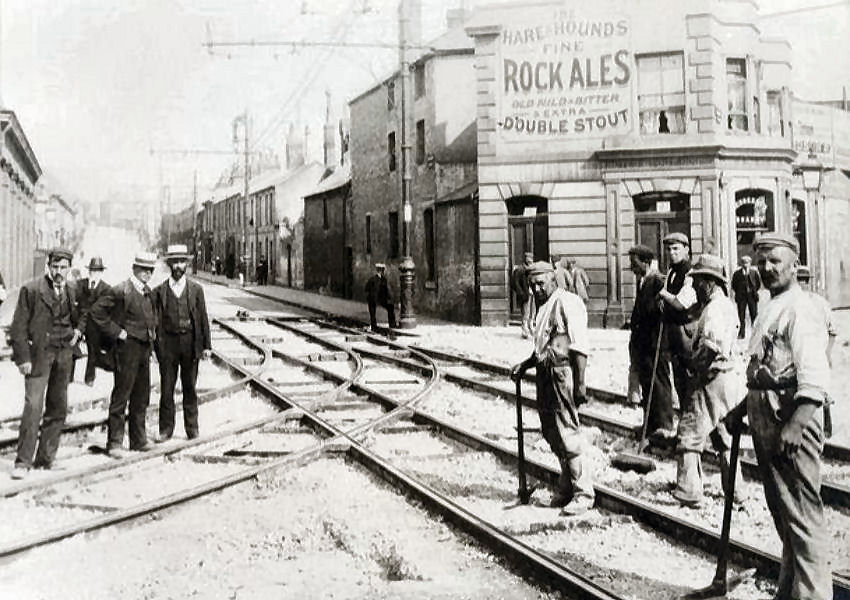
Double Track (Major Roads): On wide roads like Lewes Road and London Road, two parallel sets of tracks occupied the centre of the street. Trams ran in opposite directions, leaving the roadsides entirely clear for horse-drawn carts and early motor vehicles. Single Track with Passing Loops (Narrow Roads): On narrower residential climbs—such as sections of Elm Grove, Ditchling Road, and Queen's Park Road—there was only enough room for a single track directly down the centre of the asphalt. To keep traffic moving in both directions, engineers built intermittent passing loops (short double-track sections) where oncoming trams could safely pull alongside each other and pass. The "Interlacing" Solution: In highly restricted bottlenecks, such as the narrowest bends of Seven Dials or parts of North Road, engineers used "interlacing" (or gauntlet) tracks. This meant two tracks overlapped down the centre of the street, using the same physical space and requiring only one set of points at each end.
Why the Centre Was Chosen
Keeping the Kerbs Free: Placing tracks in the centre prevented trams from blocking shopfronts, businesses, and houses. It allowed delivery wagons and horse carriages to park at the kerb without disrupting the tram schedule. Overhead Wire Alignment: Because the tracks ran straight down the middle, the overhead electric cables could be suspended perfectly on the centreline. This allowed the tram's roof-mounted trolley poles to maintain a steady, straight-line connection with the power grid. Pedestrian Safety: Brighton’s streets were bustling with shoppers. Keeping the massive, heavy trams in the centre of the roadway provided a safety buffer between the vehicles and pedestrians walking on the pavements.
How the Road Was Constructed
To withstand the immense weight of the trams, the centre of the road was built differently from the sides: The Foundation: Workers dug out the centre of the street and poured a thick bed of concrete to support the iron rails. The Road Surface: The area between the rails (and 18 inches on either side) was paved with granite setts (stone blocks) or hardwood timber blocks. This stopped the road surface from cracking under tram vibration. The Disappearance: When the system closed in 1939, ripping up miles of steel rails was too expensive. Instead, contractors simply lifted the overhead wires and tarmacked directly over the rails. Consequently, the original tracks and granite setts still sit perfectly preserved just inches beneath the modern asphalt of Brighton's main roads today.
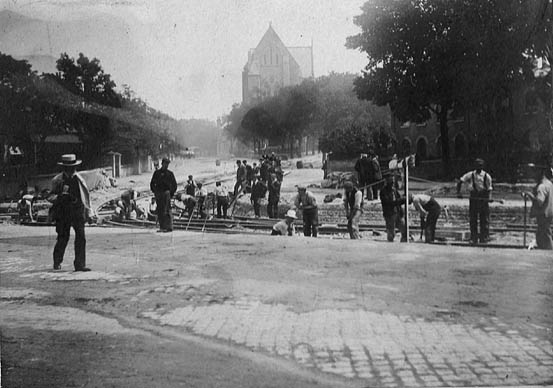
Elm Grove (Rote E & Route Q: This was universally feared by drivers (motormen) as the most dangerous section of track on the network. Trams climbed straight out of the valley up to the Race Hill. The gradient maxed out at a punishing 1 in 11 (approx. 9%), meaning for every 11 feet travelled forward, the tram climbed 1 foot. Ditchling Road (Route D): Running north ard Hollingbury, this line encountered continuous, prolonged climbs. It featured steep sections of 1 in 13 (approx. 7.6%) that severely taxed the electric motors on the way up and required immense braking pressure on the way down. Dyke Road (Route N): Trams climbing from Seven Dials up toward the reservoir regularly faced severe inclines of 1 in 15, often worsened by standard coastal dampness making the rails slick.
The Multi-Stage Braking System
To prevent catastrophic runaway vehicles on these steep hills, Brighton’s double-decker trams were outfitted with a three-tier braking layout. Motormen had to manually orchestrate these systems simultaneously when descending places like Elm Grove: The Hand Brake (Wheel Brake): A traditional chain-driven brake operated by a large brass wheel on the driver’s platform. This forced cast-iron brake shoes directly against the wheel rims. The Track Brake (Slipper Brake): Crucial for the centre-of-the-road alignment. Using a large hand-lever, the motorman mechanically forced heavy blocks of wood (often sustainably sourced poplar or oak) directly down onto the top of the iron rails. This used the tram's weight to create immense friction independent of the spinning wheels. The Rheostatic (Electric) Emergency Brake: If the wheels began to lock up and skid on the hills, the driver could reverse the electric motors. This turned the motors into generators, creating powerful magnetic resistance that rapidly slowed the vehicle. A Westinghouse Air-powered wheel braking system replaced the mechanicl braking system and was first introduced mid 1920's on the Class D Brighton designed & built trams, air braking became standard on later Classes E and F. Tram 53 had the fully developed Westinghouse system operating on both the wheel and track brakes.
The Constant Threat of "Slick Rails"
The absolute worst enemy of Brighton's hill-climbing trams was the weather. Being a coastal town, sea mist, sea foam, and autumn leaves frequently coated the tracks. This created a highly lubricated, greasy layer on the steel surface. If a motorman applied the wheel brakes too hard on a hill like Elm Grove, the wheels would completely lock, the tram would lose all adhesion, and it would begin tobogganing helplessly down the centre of the road. To combat this, every tram featured gravity-fed sandboxes mounted under the seats. By stepping on a foot pedal, the driver dropped sharp grit directly onto the rails just inches in front of the wheels to instantly restore friction.